The task
A content site stands or falls on its structure. The portal had to hold hundreds of materials and stay navigable: by country, by topic and by date, with short news and long guides living in the same feed.
The second part is what search sees. The topics were mapped before anything was written, so that each page answers one query and the sections support each other instead of competing for the same words.
What we built
The portal in one screen
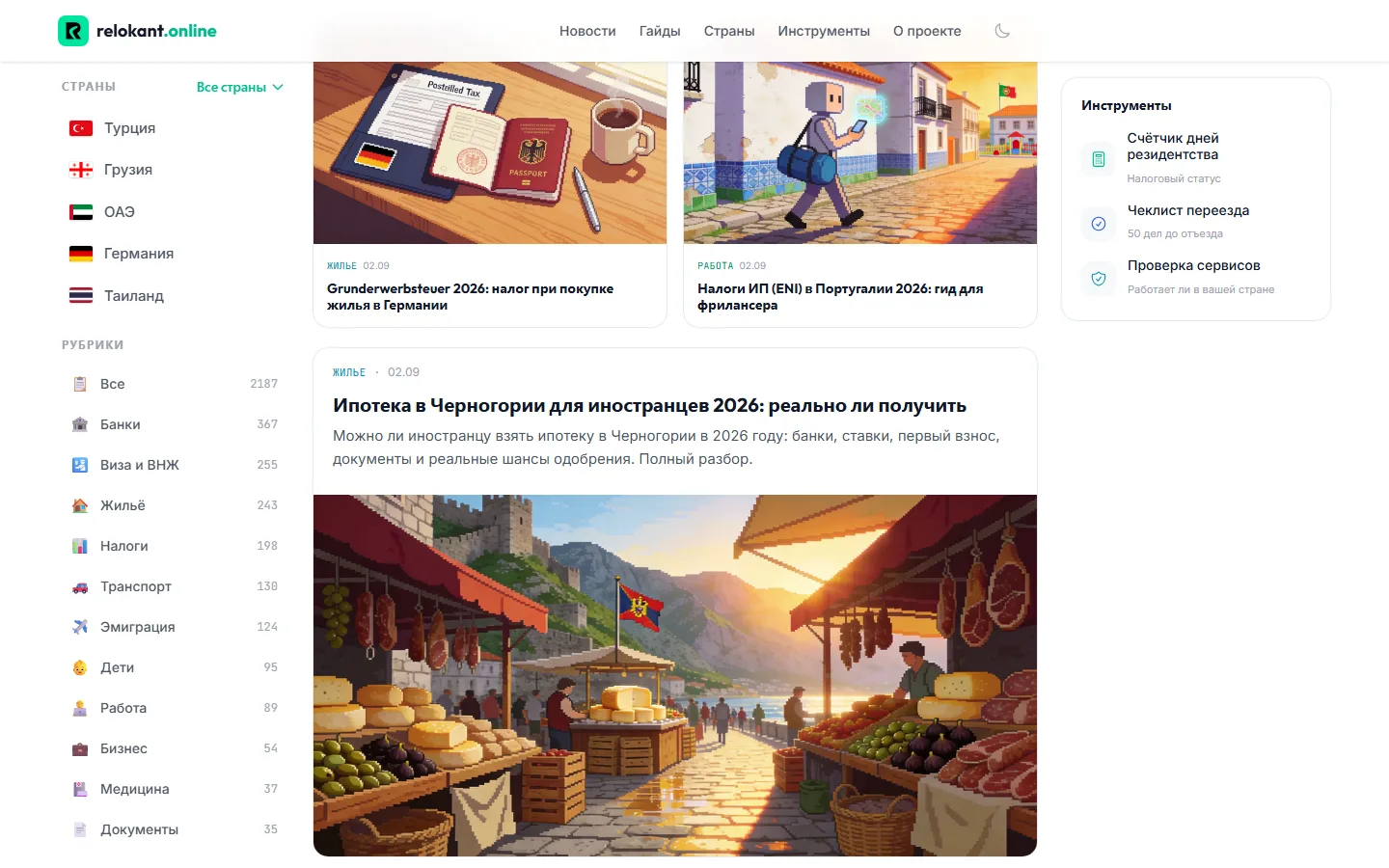
The home page shows the whole structure at once: countries down the left, topics under them with the number of materials in each, news at the top of the feed, and the tools on the right.
A reader who arrives from search on a single article can move sideways from it, to the country, to the topic, to a tool, without going back to the search results. That is what keeps a large site from behaving like a pile of separate pages.

A media website with hundreds of pages
The feed mixes news and guides. Each card carries the topic, the date and one line about what is inside, and every article is illustrated in one style, so a long feed still reads as one publication.
The layout is made so that another hundred pages change nothing structurally: a new article picks its country and its topic and lands where readers already look for it.
The keyword map under the editorial plan
Before the writing came the map: which queries exist around each country and each topic, which of them deserve a page of their own and which belong inside an existing article. The editorial plan is built from that map, not the other way round.
The topics with the most demand carry the most material: banking, visas and residence permits, housing, taxes. That is visible in the counters next to each section.

Written for search and for AI answers
Pages are written so that a machine can quote them: the answer sits near the top, the headings say plainly what is under them, and the facts are stated as facts rather than built up to. That is what an assistant needs when it composes an answer and names a source.
The tools are part of the same plan. A residence-day counter, a moving checklist and a service checker answer queries of their own and give the portal pages that are not articles.
Under the hood
The portal is filled by a system that runs on a server of its own. Below is what it watches, how a text travels from a signal to a published page, and what the site shows a search engine.


Editorial pipeline
What the system watches every hour
Every hour the server goes round 49 government sites in 34 countries, 32 news feeds and 22 currency pairs from the central bank.
Three tracks for three kinds of signal
A model reads each signal and sends it down one of three routes: a short note of fifty to a hundred words, a news item of three to six hundred, or a long guide that a person reviews before it goes out.
Nine steps from signal to page
Every article goes through the same chain: a check for duplicates, an outline, a draft, an edit, a fact check, formatting, its own illustration, a review report and only then the publish.
Gates before the site goes out
Three scripts check a build before it is deployed: the build itself, the format of the articles and the publishing rules.


Search and markup
A sitemap of 2,276 addresses
The sitemap listed 2,276 addresses on the day of the audit, generated by the site itself rather than kept by hand. The sitemap
Rules for the AI crawlers
robots.txt lets in the crawlers of the language models — GPTBot, ChatGPT-User, ClaudeBot, PerplexityBot, Google-Extended and others — and shuts out two that take the text without sending readers back. llms.txt
Markup for articles and news
Articles carry JSON-LD markup of the Article, NewsArticle, FAQPage and HowTo types, and the home page declares the site and the publication.


Delivery and privacy
The feed for readers and aggregators
The portal publishes an RSS feed, so aggregators and reading apps pick new material up without anyone visiting the site. The RSS feed
Pictures and delivery
The pictures are served from a separate image domain, most of them in webp, and all but the first two load as the reader scrolls to them.
The privacy page and the counters
The privacy policy is published and linked from the footer. Privacy policy
On a phone

What came out of it
- Hundreds of content pages and steady search traffic
- Countries, topics, news and tools in one structure
- Pages written so that AI answers can quote them
The portal now runs on its own structure. A new article picks a country and a topic, lands in the feed and in the sections, and starts collecting search traffic without anything being rebuilt. Publishing is editorial work now, not development.