The task
A shop in Russia gives the bank a percentage of every card payment. Instant bank transfer costs much less, and half the country already pays that way. The buyer picks it when it is the first thing on the checkout page.
So there were two jobs at once. Build the product: a checkout page, a dashboard, billing and a calculator that counts on the shop's own turnover. And build a landing page that explains it to an owner who is not a developer.
What we built
A landing page that says the offer in one screen
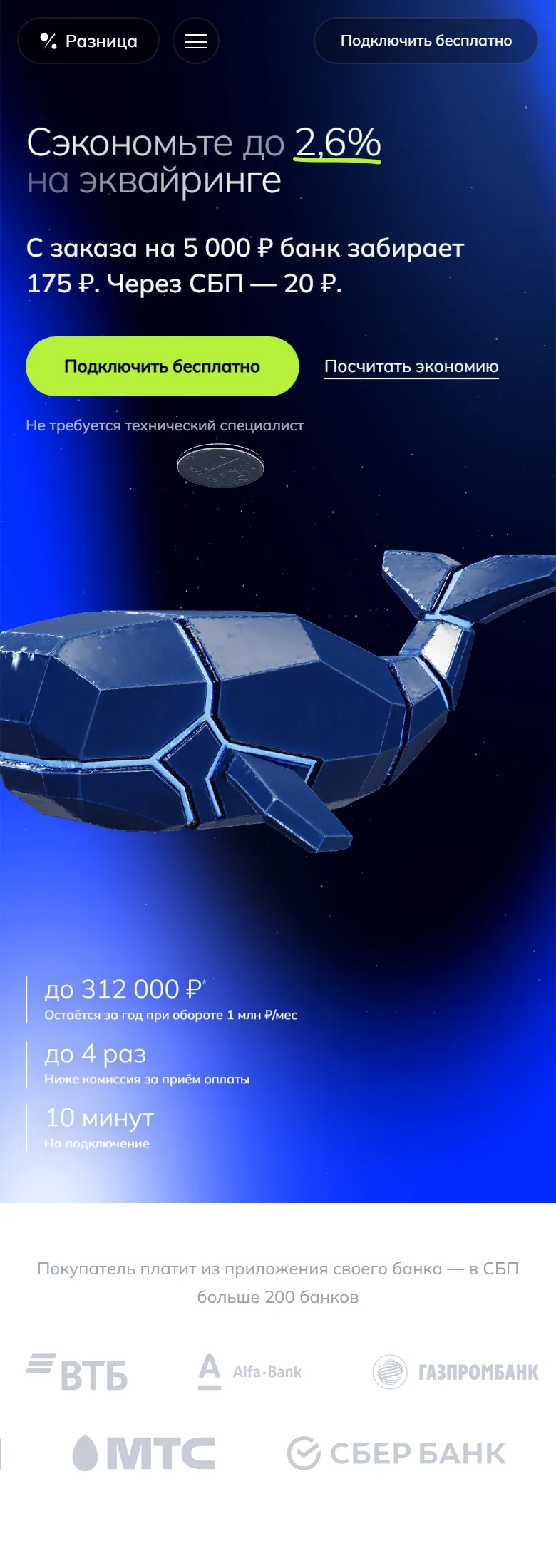
The first screen states the offer with one example: what the bank takes from a 5 000 ₽ order and what instant transfer takes. Behind it runs a 3D scene on a deep blue mesh gradient.
Below the fold the page is built of blocks: bank logos scrolling past, the rates, the segments the service fits, and the questions people ask before connecting.
The checkout page and how a shop connects it
The checkout page opens with instant bank transfer. The buyer pays in two taps from their own bank app, and card payment stays one tap away under the other methods. Money goes to the shop's existing payment account, the way it did before.
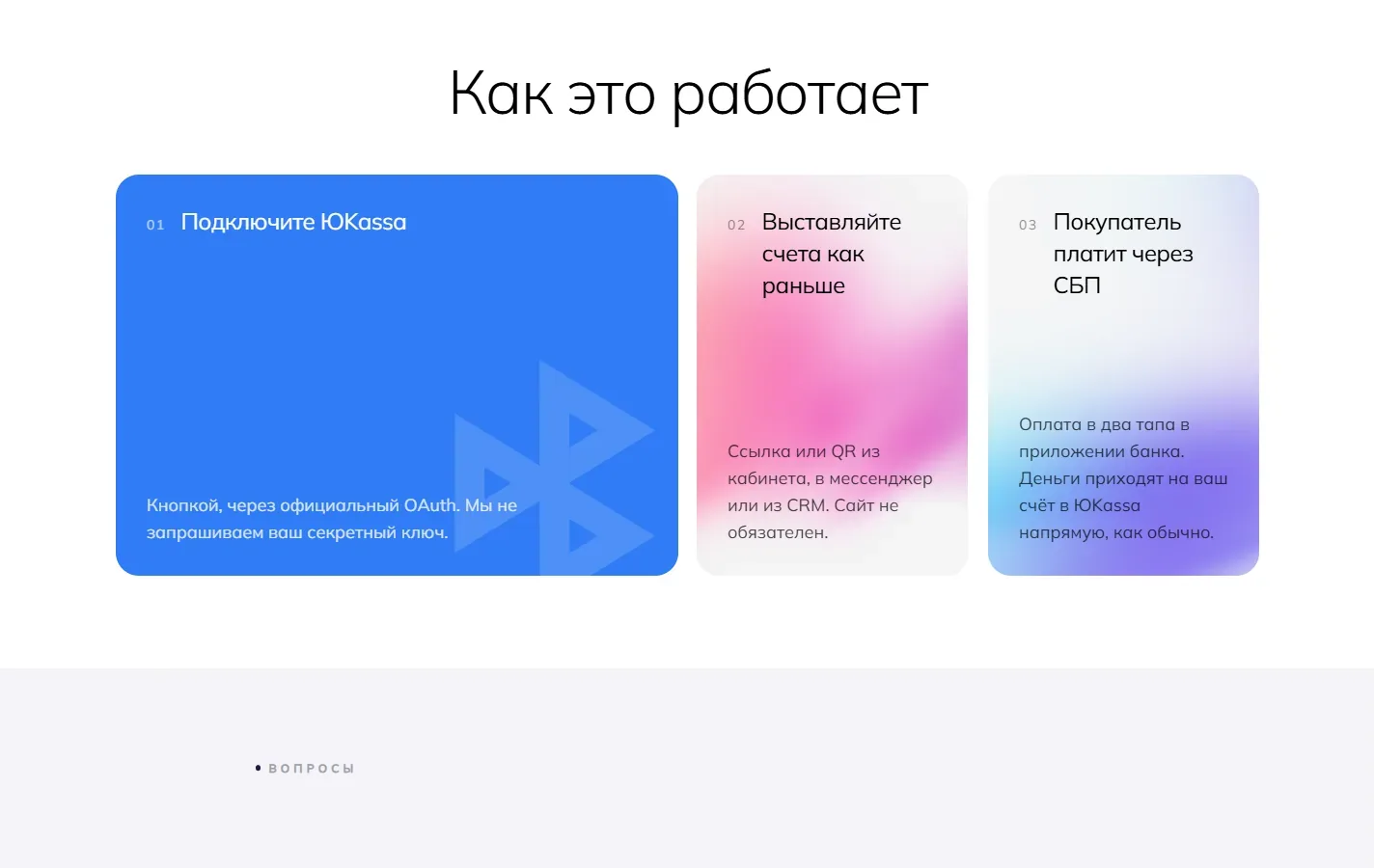
Connection runs through official OAuth, so the shop's secret key is never requested and access can be revoked at any time. An invoice goes out as a link or a QR code from the dashboard, which means a shop can take payment even without a site.
A savings calculator that counts on your own turnover
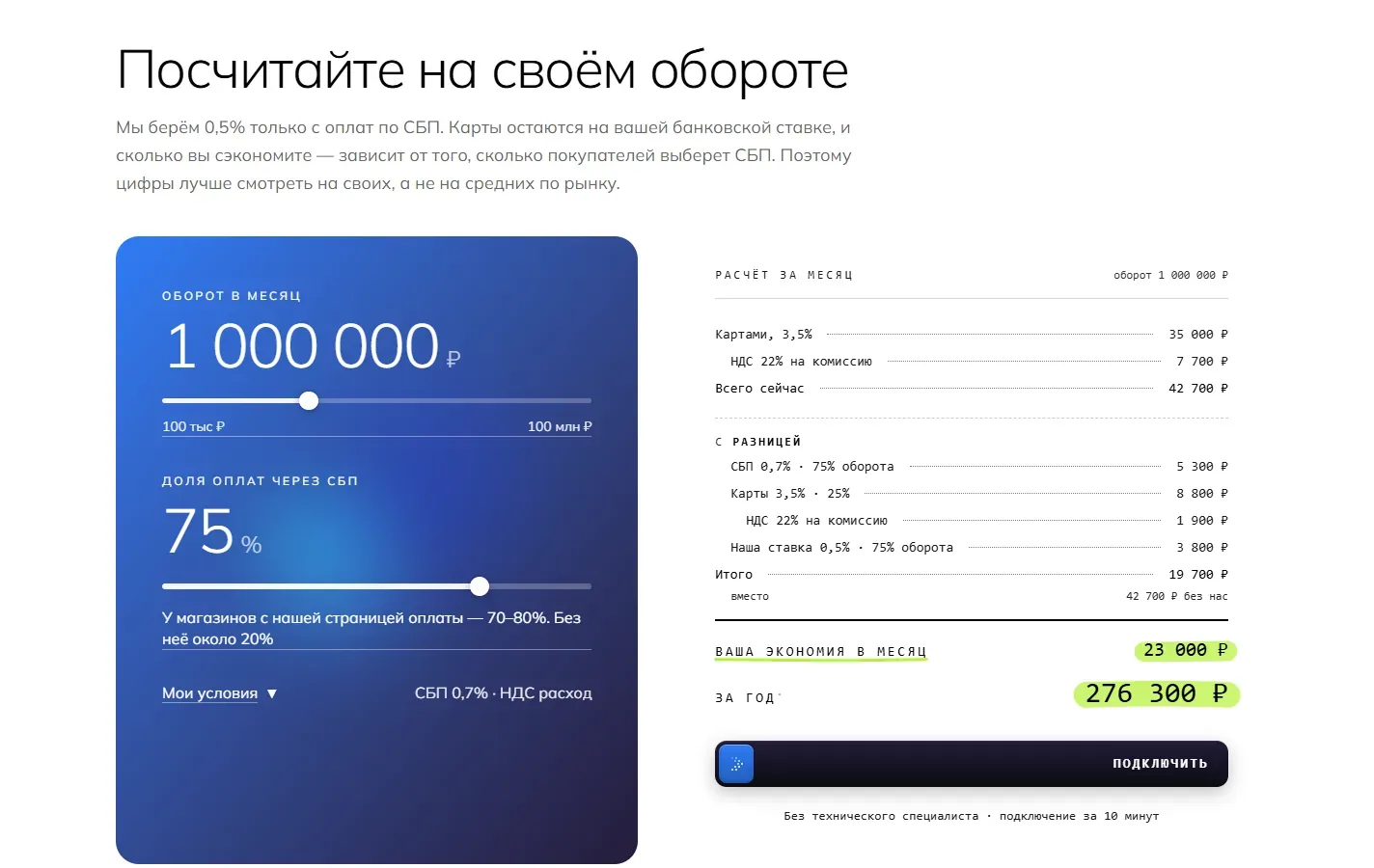
Average market figures convince nobody, so the page asks for your own. Sliders set monthly turnover and the share of buyers who pay by instant transfer, and a third field opens the shop's own rates.
The result is laid out as a bill: what the shop pays now, what it pays with the service, the fee on top, and the saving per month and per year. Every figure recalculates as the slider moves.
The blocks that answer a shop owner's questions
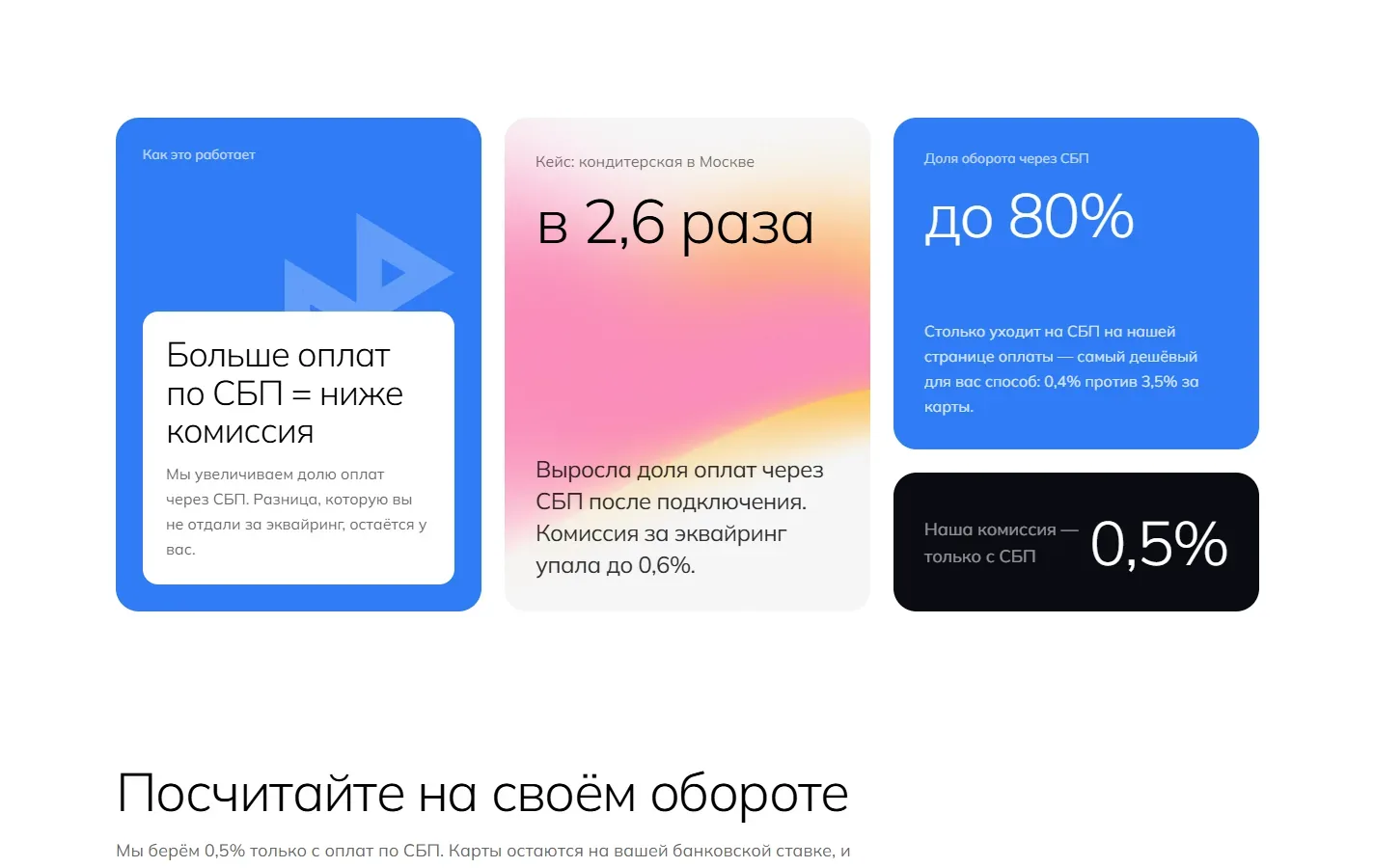
A payment service is a thing people are careful with, so the middle of the page is given to plain answers. Where the money lands, what the fee is taken from, what happens to receipts, what happens if the balance runs out.
The same block carries the figures the service publishes about itself, and the list of questions sits under it as an accordion.
Under the hood
Under the site runs a working payment product. This is what it is built from: the markup search engines and AI answers read, the support bot, the payment integrations and the paperwork Russian law asks for.


Search and AI answers
Structured data for search
The page carries JSON-LD for Organization, WebSite, SoftwareApplication and FAQPage, so a search engine reads the company, the product and the questions as data instead of pulling them out of the text.
A sitemap of 47 addresses
The site builds its own sitemap and robots.txt points at it, so a crawler is handed the list instead of looking for pages by chance. Open sitemap.xml
Open to AI search
The site serves llms.txt, a short file that tells an AI assistant what the service is and where the answers are. Open llms.txt
Link previews in messengers
The head carries og:title, og:description, an og:image and twitter:card set to summary_large_image.


Support
The support bot Vera
Vera answers in the chat widget on the site, in Telegram and by email, all from one place. Open the support bot
A knowledge base kept in git
The bot answers from 35 articles written in Markdown and versioned in git.


Money
Billing settled every day
The fee the service takes is counted in its own ledger and settled daily.
Modules for WooCommerce and Tilda
A shop on WooCommerce installs a payment plugin that verifies the signature on every callback from the payment side and comes with its own test suite.

Law
Cookies, consent and Russian data law
The cookie banner opens a preferences window, and Yandex Metrika loads only after consent to analytics. Read the privacy policy


Reliability
Tests and automatic deploy
About sixty test files cover billing, payment callbacks, reconciliation and the tariff, plus end-to-end tests that run against the built site.
On a phone
Stickers for the messengers
The brand character as a sticker pack: sent to customers in Telegram, used in posts and mailings.


















What came out of it
- Payments by instant transfer grew 2.6 times and the acquiring fee halved.
- A shop connects through official OAuth without a developer on its side.
- Invoices go out as a link or a QR code, so payment works without a site.
The site does two jobs now. It explains a payment service in words a shop owner uses, and it lets that owner check the saving on their own numbers before talking to anyone. Sign-up starts from the same page.